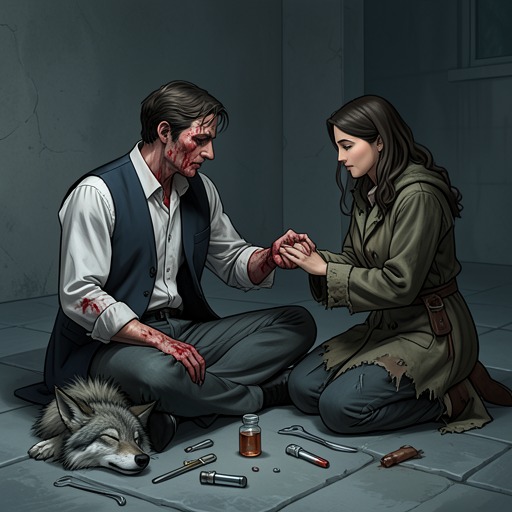
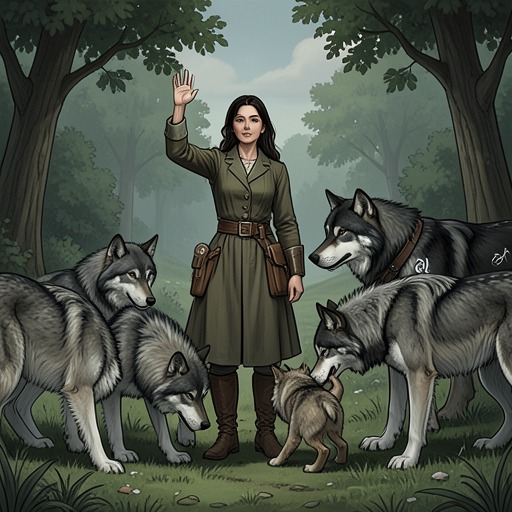
The twins accept Sierra
Broken Rejected MateThe twins accept Sierra is a crucial reconciliation in Sierra’s movement from concealed outsider to trusted member of the Blue Blood Pack. Andrew Lowell and Anthony Lowell had regarded her as a threat after discovering her hidden identity, but a family conversation leads them to recognize their own conduct as unjust. Their acceptance does not erase the danger surrounding Sierra; it changes the social ground on which she faces it, replacing isolation with protection, practical companionship, and the first credible promise of pack belonging.
Suspicion and the Crisis of Identity
Sierra approaches the twins’ reconciliation from a position of mutual distrust. She has concealed her true identity because she feared being killed, while Andrew Lowell and Anthony Lowell have interpreted that concealment as evidence that she might harm them. Their hostility is therefore built from two incompatible forms of self-protection: Sierra hides in order to survive, and the twins attack or exclude her because they believe secrecy makes her dangerous. The conflict is intensified by the fact that Sierra is already connected to Alan Lowell, making her identity a personal and pack-wide concern rather than a private secret.
The earlier atmosphere of hostility is reflected in the twins’ behavior after Sierra arrives. Andrew Lowell later distinguishes his own conduct from that of his brother, claiming that he had treated her well until the secret was discovered. That qualification reveals that acceptance will not come through a single abstract declaration; it must address a series of concrete slights and antagonistic acts. Sierra, meanwhile, does not demand that the twins immediately become intimate with her. She wants recognition that she was protecting herself, and she promises that she will not use her hidden nature to hurt either of them.
The Conversation and Apology
The change begins after Alan Lowell and his cousins have a long conversation. When Sierra sees the red car that had nearly crushed her legs the previous day, she initially assumes that Alan Lowell, Andrew Lowell, and Anthony Lowell have come for her as part of a trap. The unexpected absence of scowls on the twins’ faces signals that the emotional balance has shifted before anyone explains why. Alan Lowell tells Sierra that the cousins agreed their behavior since her arrival had not been acceptable and that they are sorry for their antics and have promised to treat her better from then onward.
Alan Lowell acts as the spokesperson for the reconciliation, but the arrangement does not remain entirely indirect. Sierra admits that she hid her identity because she did not want to die and frames the concealment as self-preservation. She also gives the twins a direct assurance that she will never hurt either of them. Andrew Lowell then apologizes to Sierra himself and gets out of the car to hug her. The physical gesture makes his change unmistakable: acceptance is no longer merely a decision discussed among relatives but an action offered directly to the person who had been treated as an enemy.
Anthony Lowell responds more cautiously. He apologizes as well, but he remains seated and only nods in Sierra’s direction. Sierra accepts this limited response, even joking that the more conciliatory twin owes her three sandwiches. The joke is important because it converts a history of hostility into a shared, ordinary exchange. Anthony Lowell has not become openly demonstrative, yet his willingness to apologize and stop treating Sierra as an adversary is enough for the relationship to begin moving forward.
From Reconciliation to Trust
The twins’ acceptance produces an immediate change in Sierra’s daily life. On the drive to school, she and Anthony Lowell manage to have a conversation without wanting to bite each other’s heads off. The scene presents reconciliation as behavioral rather than ceremonial: trust is established through the disappearance of reflexive aggression, through the ability to occupy the same confined space, and through conversation that no longer threatens to become a fight.
The effect spreads beyond the twins. Once the rest of Sierra’s friends see Andrew Lowell and Anthony Lowell accept her, they gradually begin to thaw as well. Sierra still has to work to make them view her as something other than a threat, but she eventually earns their trust. They even defend her against other werewolves at school who are looking for an opportunity to attack her. The twins’ decision thus functions as a social permission structure. Their change in attitude gives others a model for reassessing Sierra and turns private reconciliation into broader communal protection.
That protection is especially meaningful because Sierra remains vulnerable even after the twins accept her. A low growl at her locker and the sudden appearance of two men and a woman who are clearly werewolves show that acceptance within one circle does not end the hostility directed at her elsewhere. The twins’ reconciliation does not make the threat disappear; instead, it ensures that Sierra is no longer required to confront every threat alone. Their support becomes part of the network that allows her to remain present in the pack’s world.
Place in Sierra’s Larger Transformation
The reconciliation anticipates Sierra’s later incorporation into pack life. Her first shift is physically devastating: her kneecap breaks first, and she falls while her aunt urges her to ease into the transformation rather than fight it. That painful threshold parallels the social threshold represented by the twins. Sierra must endure the fracture of an old human identity and the resistance of a community that does not yet know how to classify her. In both cases, survival depends not on pretending that the transformation is painless, but on learning to move through it with guidance and support.
Sierra’s acceptance by the twins also contrasts with the coercive invitation made by another pack leader, who asks both Sierra and Doherty Langford to join his pack. That demand treats pack membership as something that can be secured through pressure. The twins’ change is different: it follows conversation, admission, apology, and a promise of improved conduct. Their acceptance gives social belonging an ethical basis, even though it begins from fear and remains incomplete in expression.
The consequences extend into Sierra’s intimate and public future. After Doherty Langford’s death, Sierra receives a ceremonial werewolf funeral for her father, with a shroud burned in the presence of Alan Lowell and a few friends. The pack’s ritual world is by then no longer wholly alien to her. Later, Sierra and Alan Lowell shift together to consummate their union and become joined body and soul, then take part in the traditional pack run, where Sierra experiences a profound sense of belonging because the pack accepts her as one of its own. By the time Sierra and Alan Lowell become the official alphas of the Blue Blood Pack, the acceptance first enacted by Andrew Lowell and Anthony Lowell has become part of a much larger transformation: the former outsider is not merely tolerated, but entrusted with leadership.
Narrative Significance
The twins’ acceptance is a value reversal from exclusion to affiliation. Before the reconciliation, Sierra’s secrecy defines her as a possible enemy; afterward, the same disclosure becomes the basis for an honest negotiation of trust. The scene also distinguishes forgiveness from instant closeness. Andrew Lowell expresses his change through an embrace, while Anthony Lowell offers only a restrained apology and nod, allowing the narrative to preserve different speeds and styles of emotional repair.
Most importantly, the event shows that Sierra’s belonging is built through repeated acts rather than granted by a single revelation. She explains her fear, promises restraint, receives the twins’ apology, survives the awkwardness of Anthony Lowell’s limited response, and then participates in ordinary conversation and shared school life. The twins’ acceptance therefore serves as both reconciliation and initiation: it restores damaged relationships while opening the path toward Sierra’s full identity as a protected, trusted, and eventually leading member of the Blue Blood Pack.